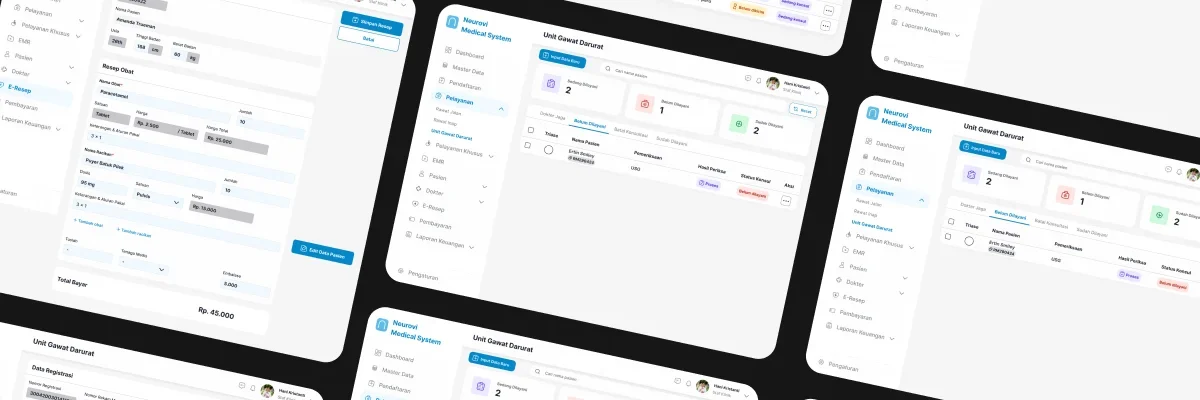
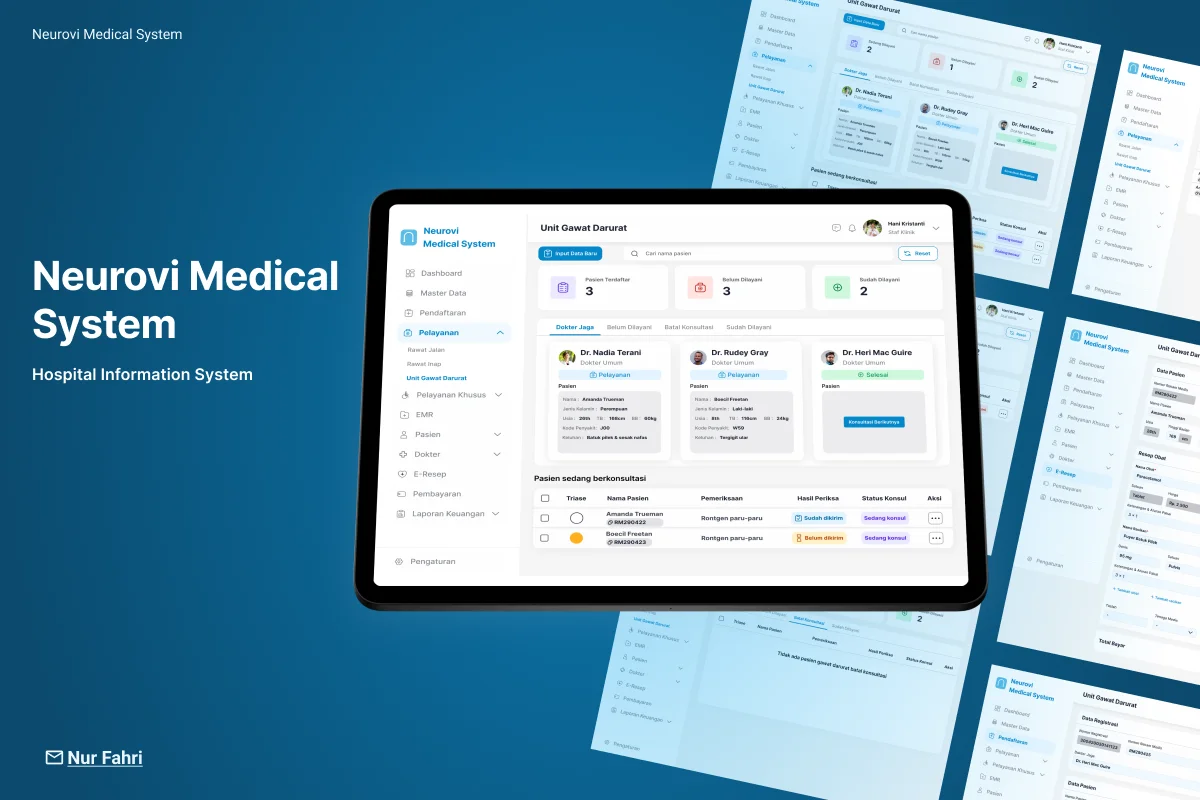
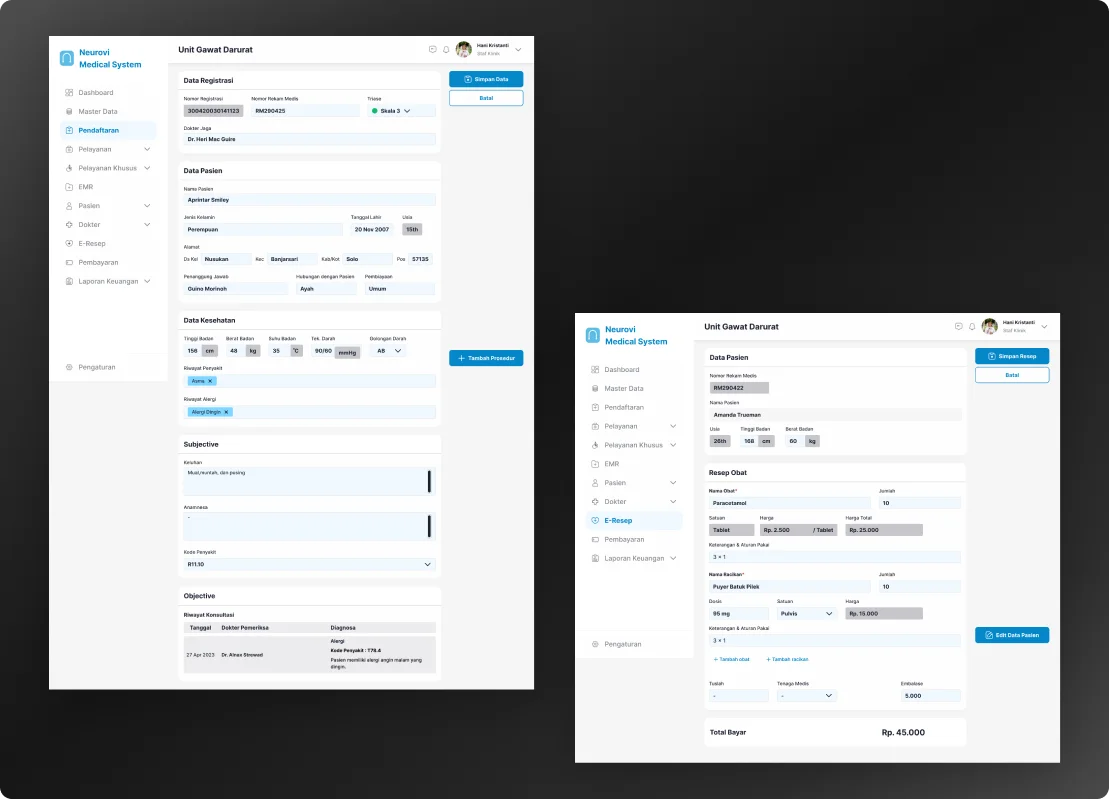
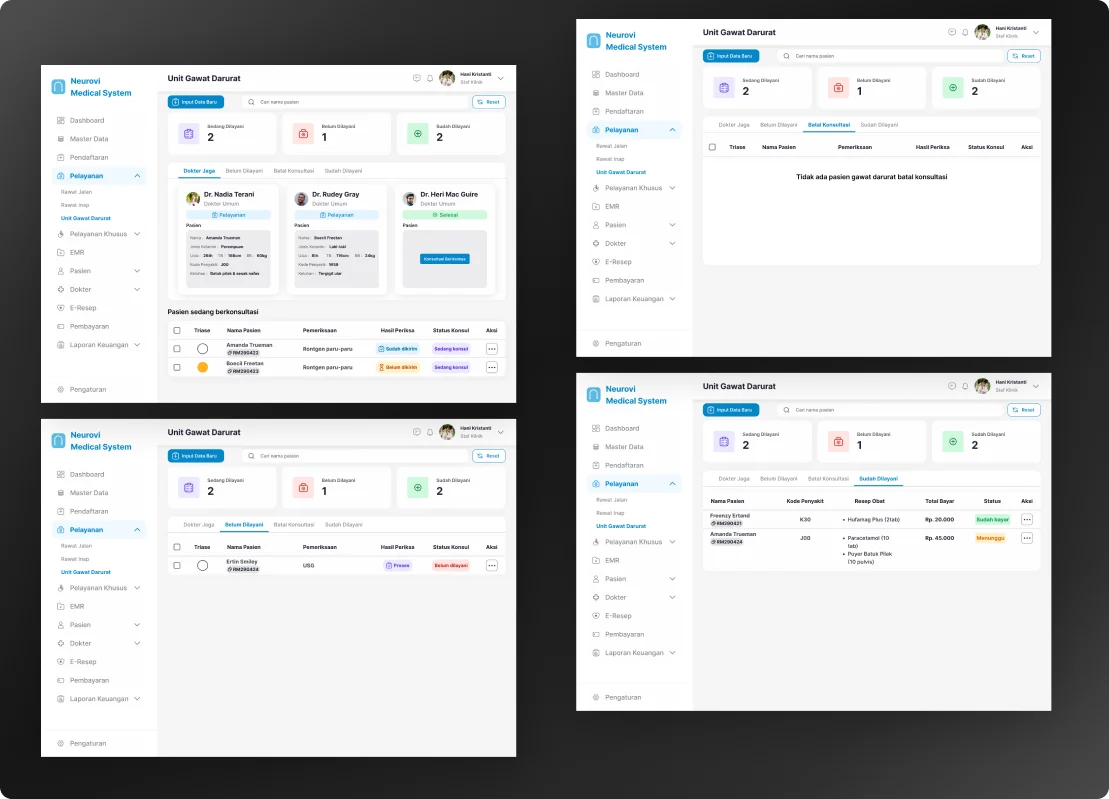
The design solution for the dashboard aims to make it easier and faster for emergency unit staff to access patient information.
Context
The Emergency Unit Dashboard in the Neurovi Medical System was designed to support medical staff by helping them manage patient data, track services, and monitor patient status.
User research was conducted to understand the needs of various roles such as doctors, nurses, radiographers, and lab staff. Using Figma, the focus was on key features like patient records, e-prescriptions, and medical order statuses to streamline the emergency department workflow.
Details
Time Frame:
Apr 23 – Apr 30, 2023
Role:
UI/UX Designer, Usability Researcher
Involvement:
Web Interface, Prototyping
Overview
Neurovi is a Hospital Information System (HIS) designed to help hospitals begin their digital transformation. Built on a cloud-based platform, Neurovi features Electronic Medical Records (EMR) that can be shared and offers Sharia-compliant medical services.
What sets Neurovi apart from other HIS systems in Indonesia is its focus on both Sharia-compliant and general hospitals. The system, developed since January 2019, has over 100 features across 15 main modules, including units like emergency, outpatient and inpatient care, pharmacy, surgery, ICU, as well as administrative units such as accounting, logistics, procurement, and customer relations. It integrates seamlessly with LIS (Laboratory Information System), RIS (Radiology Information System), and BPJS Health Web services.
Challenge
The goal was to design a functional and user-friendly Emergency Unit Dashboard for the Neurovi Medical System. The challenge was to understand the needs of various roles, like doctors, nurses, and lab staff, to create a dashboard that helps manage patient data and track services.
Competitive Analysis
Competitive analysis involves studying similar products in the market to understand their strengths and weaknesses. By comparing features, user experiences, and designs, we can identify opportunities for improvement and differentiate our product to provide better value for users.
Strengths
- Detailed information on all patients
- Clear patient data entry flow, making it easier for users
- Complete registration input fields
Weaknesses
- Too much information is displayed on a single screen
- No specific features for the emergency unit
- Navigation is too lengthy
- The interface feels monotonous
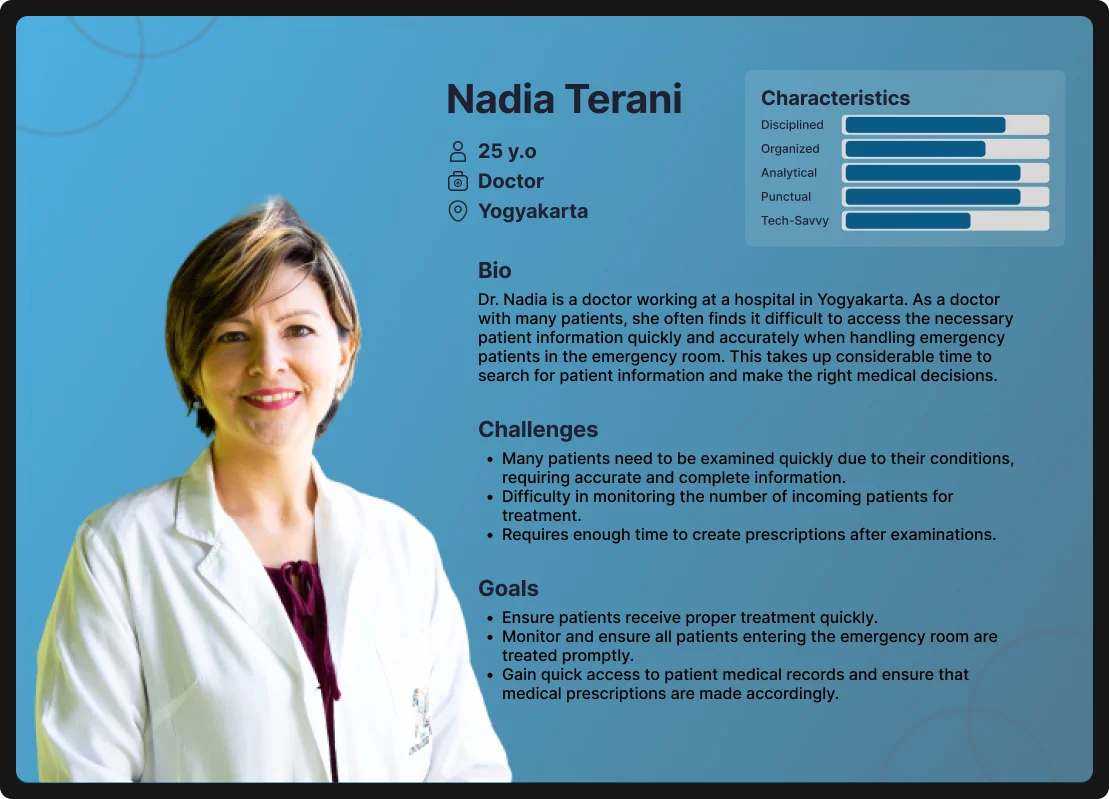
User Persona
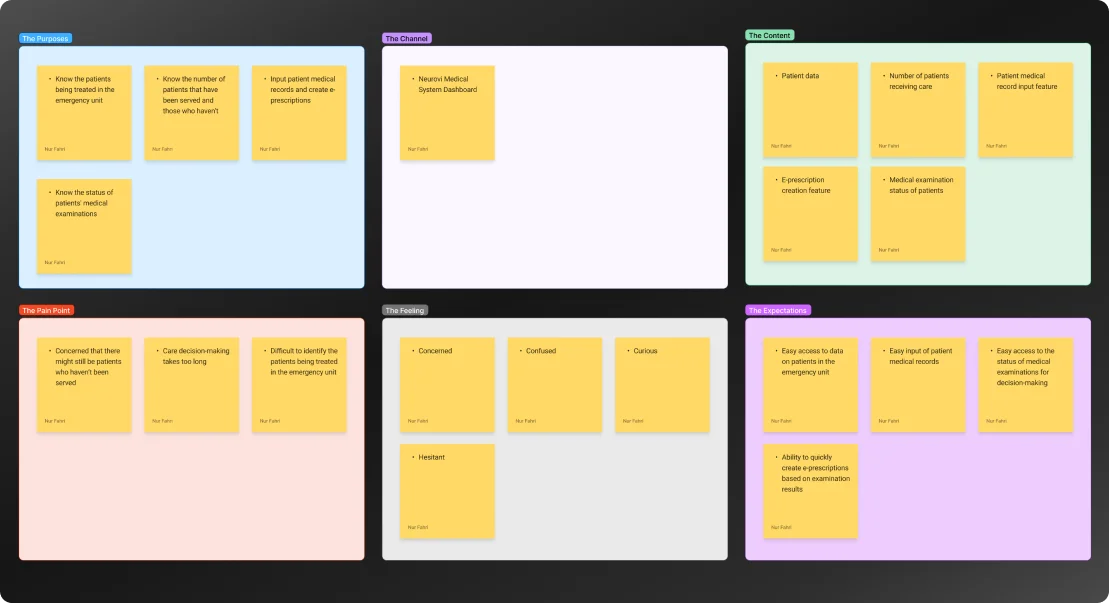
Affinity Mapping
Affinity mapping is used to organize user research data into related groups to identify key insights. It helps visualize user needs and behaviors by categorizing data into the following sections:
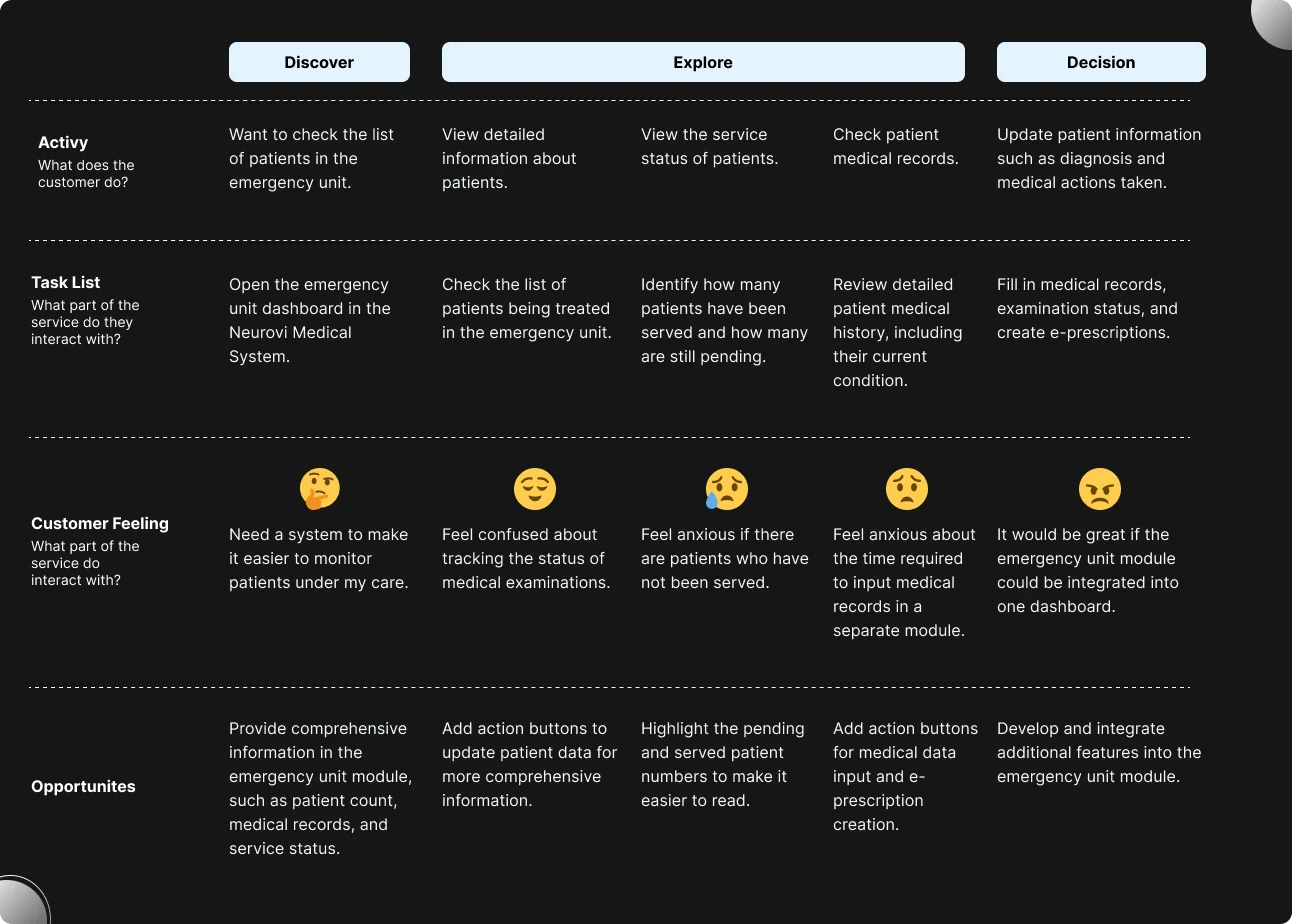
User Journey Map
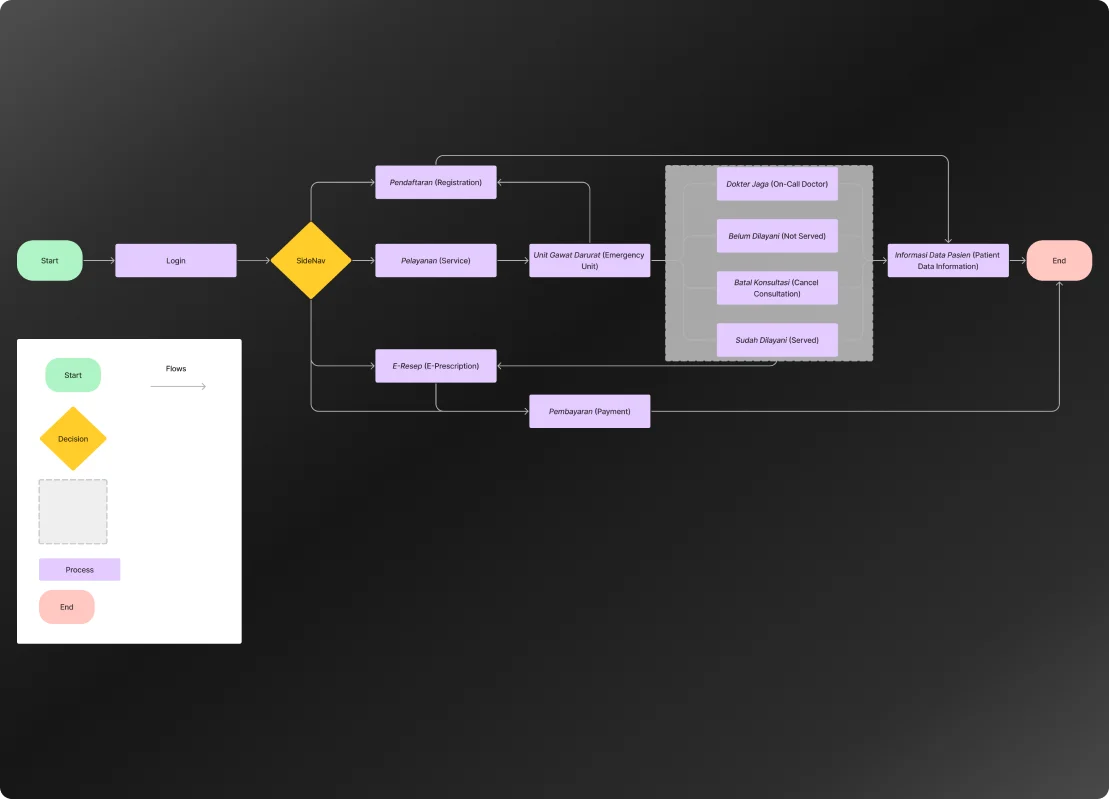
User Flow
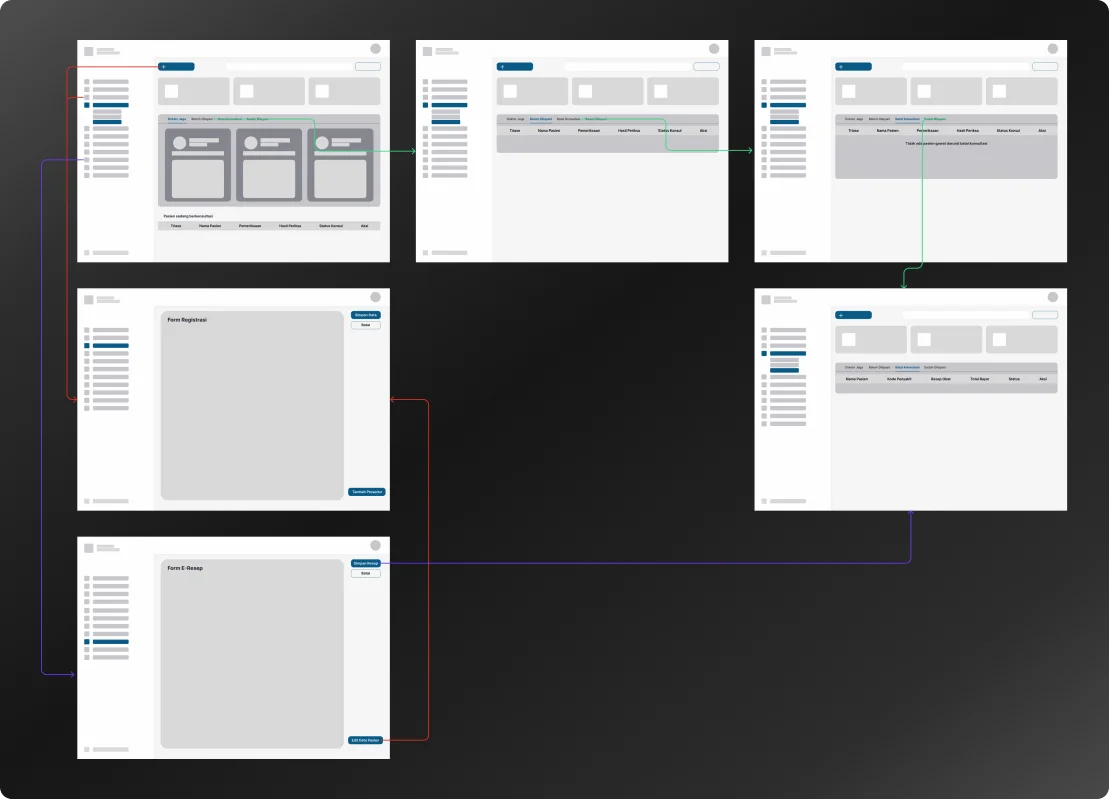
Wireflow
The Wireflow for Neurovi combines wireframes and user flow to visually represent the interactions and steps that medical staff take when navigating the emergency unit dashboard. By visualizing this journey, Wireflow helps ensure the design is intuitive, streamlined, and effective for emergency department staff, enabling them to make quicker and more informed decisions.
Design System
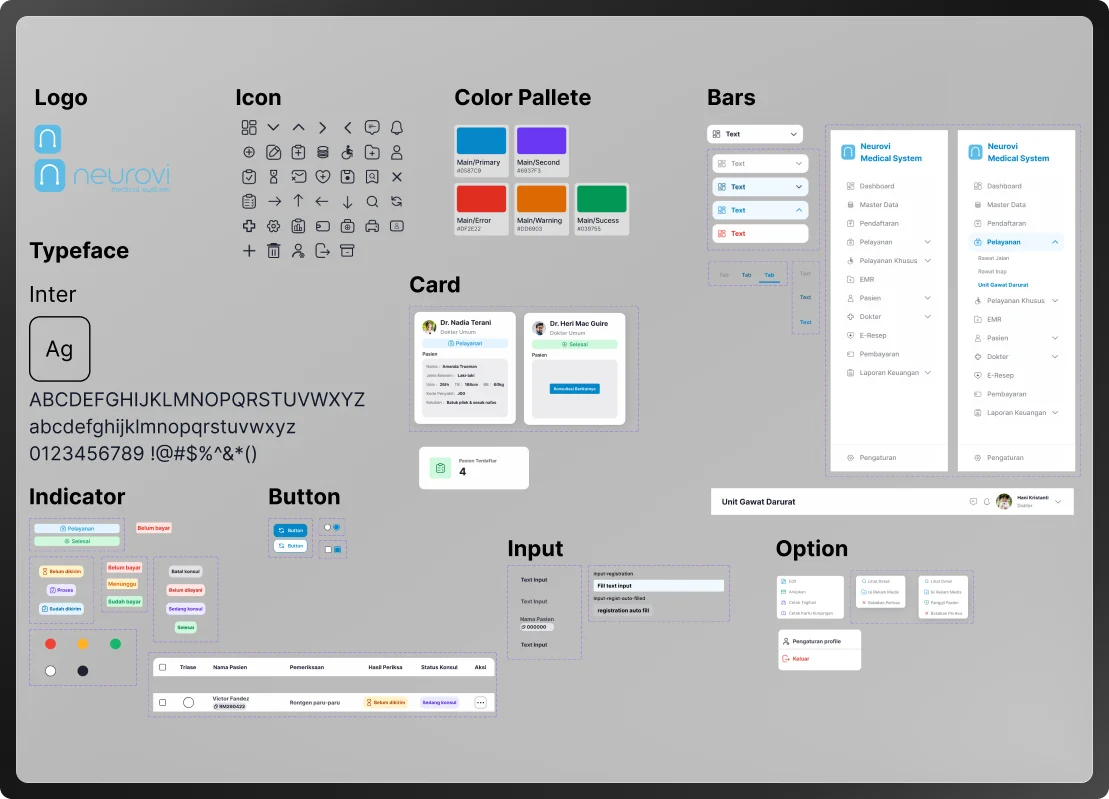
The Design System for Neurovi helps make the design process faster and more consistent across screens. It includes components like buttons, icons, and forms, along with design guidelines such as colors and typography.
By using this system, we ensure a seamless experience and maintain consistency throughout the emergency unit dashboard and other features.
High Fidelity
Prototype
Here’s the interactive prototype! You can click through the screens and experience the flow like a real user. This prototype lets you see how everything works, how the elements interact, and gives you a feel for the user experience before development starts.
Takeaways
I started working on this project three days after the task was assigned. However, this did not stop me from delivering the best design, paying attention to every detail. This is reflected in the fact that I submitted the final design on time.
Despite the limited time, I still conducted user research by distributing surveys and doing desk research on competitors. However, due to time constraints, I couldn’t conduct usability testing.
Through this process, I learned a lot about designing management information systems, especially for hospitals. I realized that it’s important to consider existing user workflows during the design process, as this impacts the development phase.